
Getting Started
Advanced Permissions lets you control exactly what non-admin users can see and do in Gravity Forms, on a form-by-form basis — so you can safely give clients and team members access without worrying about them breaking something or seeing data they shouldn’t.
Advanced Permissions controls two things:
- Form Permissions: what a user can access and edit in a form’s settings, fields, notifications, confirmations, and add-on feeds
- Entry Permissions: which specific entries a user can see once they have access to a form
Here’s the short version of how they differ:
| Controls | Example | |
| Form Permissions | Which parts of a form’s setup a user can view or edit | Let a client edit notifications but not delete the form |
| Entry Permissions | Which individual entries a user can see | Let a sales rep see only entries assigned to their region |
Form Permissions
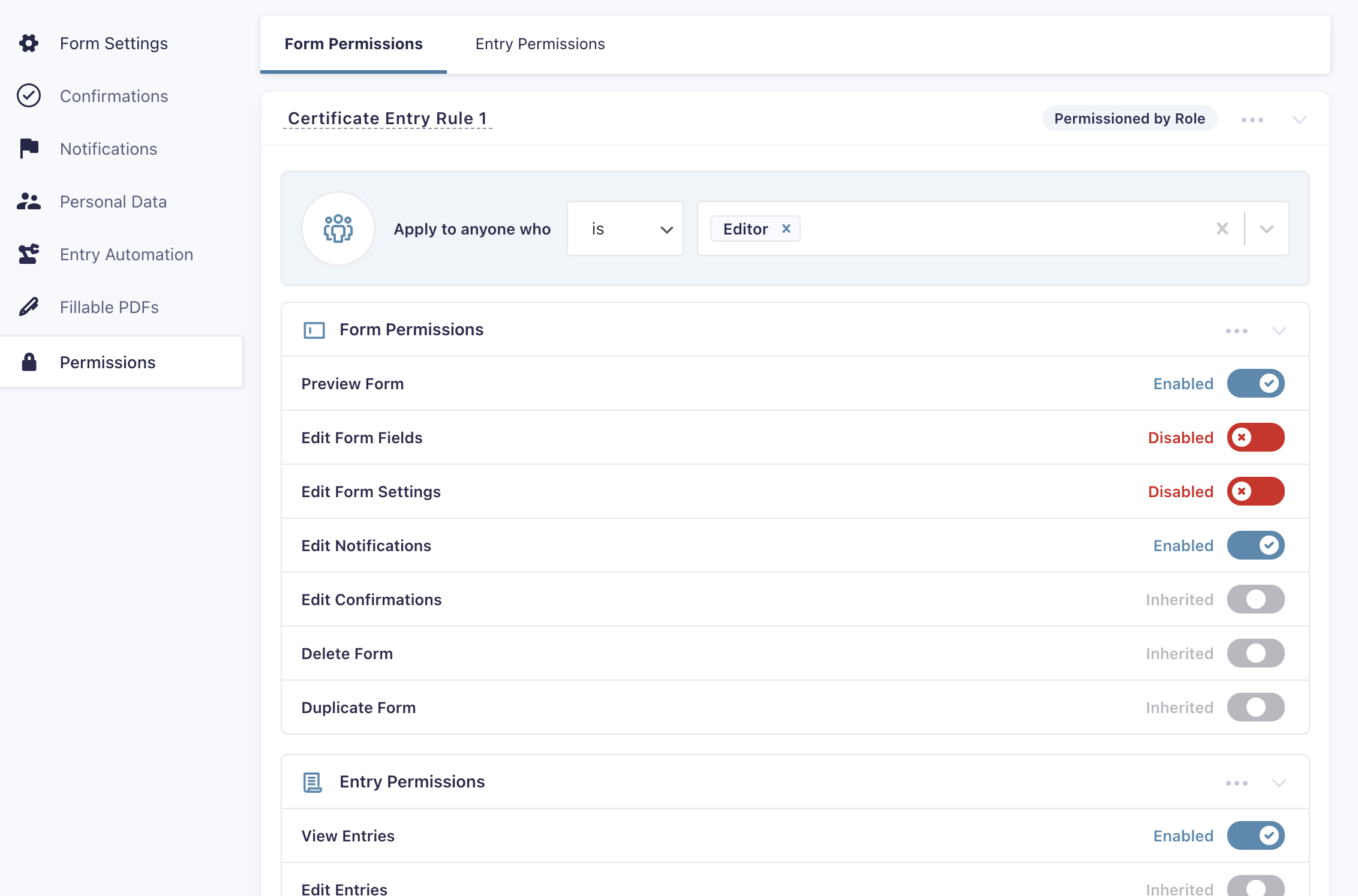
Form Permission rulesets control access to a form’s settings, fields, and add-on feeds inside the WordPress admin.
For example, you can give a user with the Editor role access to view form entries, edit notifications, and manage feed settings for one specific add-on while blocking everything else on that form.
For step-by-step setup instructions, see Setting Up A Form Permissions Ruleset.
Entry Permissions
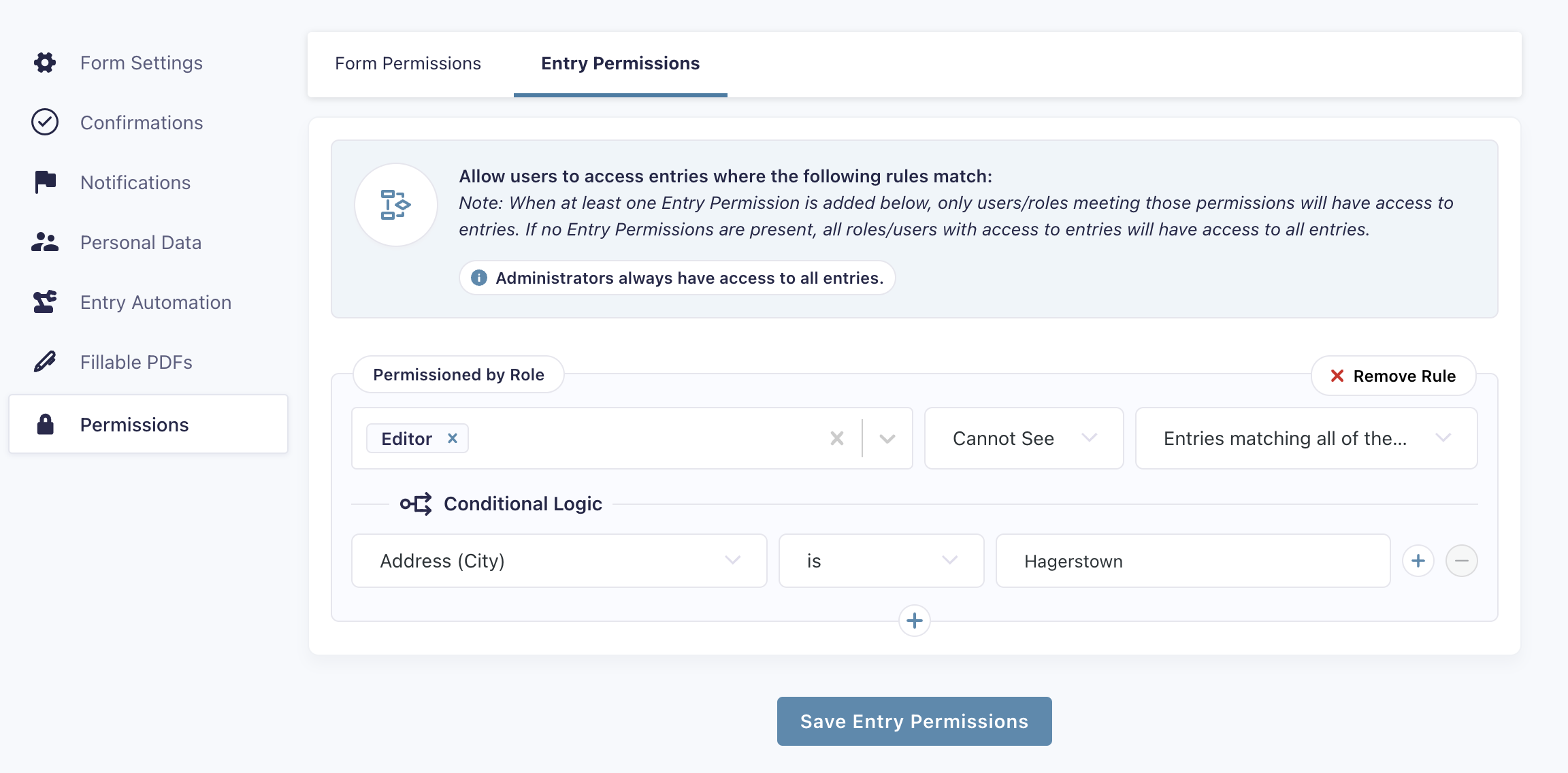
Entry Permission rulesets use conditional logic to control which specific entries a user can see for a given form.
This lets you give a non-admin user access to a form’s entries while limiting them to only the entries relevant to them — keeping sensitive data more secure and cutting down on clutter for users who only need to see their own submissions.
Before you start: Entry Permissions rulesets require a Form Permissions rule that grants the user or role the View Entries capability first. Without it, they won’t be able to access the entry list at all — so set up a Form Permissions ruleset first if you haven’t already.
For step-by-step setup instructions, see Setting Up An Entry Permissions Ruleset.